





🪐 Introduction
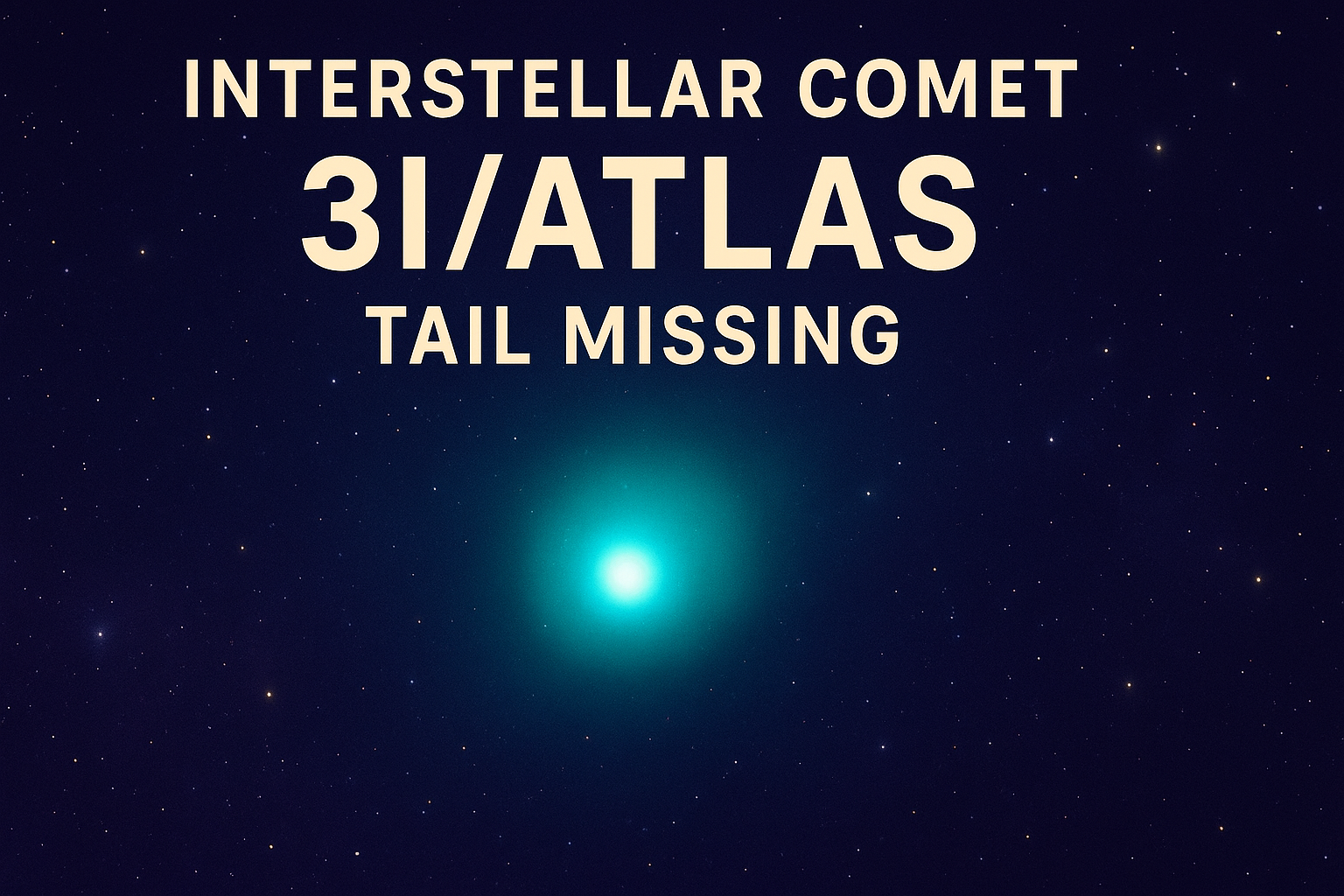
The universe is full of surprises, and one such surprise has come in the form of Interstellar Comet 3I/ATLAS. This rare space visitor has left scientists puzzled because it looks nothing like an ordinary comet. Usually, when a comet passes close to the Sun, it forms a bright glowing tail made of gas and dust. But 3I/ATLAS broke this rule — its tail is missing.
Astronomers who spotted it say the comet still looked beautiful, even though it didn’t behave the way they expected. This strange event has sparked global curiosity about what 3I/ATLAS really is, where it came from, and what its mysterious behavior tells us about the cosmos.
Table of Contents
🚀 What Is 3I/ATLAS?
3I/ATLAS (also known as C/2025 N1) is an interstellar comet, meaning it came from outside our Solar System. It is only the third interstellar object ever discovered, following the famous ‘Oumuamua (1I/2017 U1) and 2I/Borisov (2019).
This comet was first spotted on 1 July 2025 by the ATLAS telescope in Chile. The term “3I” stands for “third interstellar object,” and “ATLAS” is the name of the survey that discovered it.
Because 3I/ATLAS is moving in a hyperbolic orbit, it is not bound to the Sun. That means it entered our Solar System, passed near the Sun, and is now heading back into deep space — never to return again.

🌞 What Astronomers Expected
Normally, when a comet approaches the Sun, sunlight heats its icy surface, causing frozen gases like water and carbon dioxide to vaporize. This forms a glowing atmosphere called a coma and a long bright tail that always points away from the Sun.
Scientists expected 3I/ATLAS to show this same pattern as it got closer to the Sun around October 2025. Early images did show a faint tail, so astronomers thought it would brighten as it neared perihelion (its closest point to the Sun).
But what they saw next shocked everyone.
🧊 The Mystery: Where Did the Tail Go?
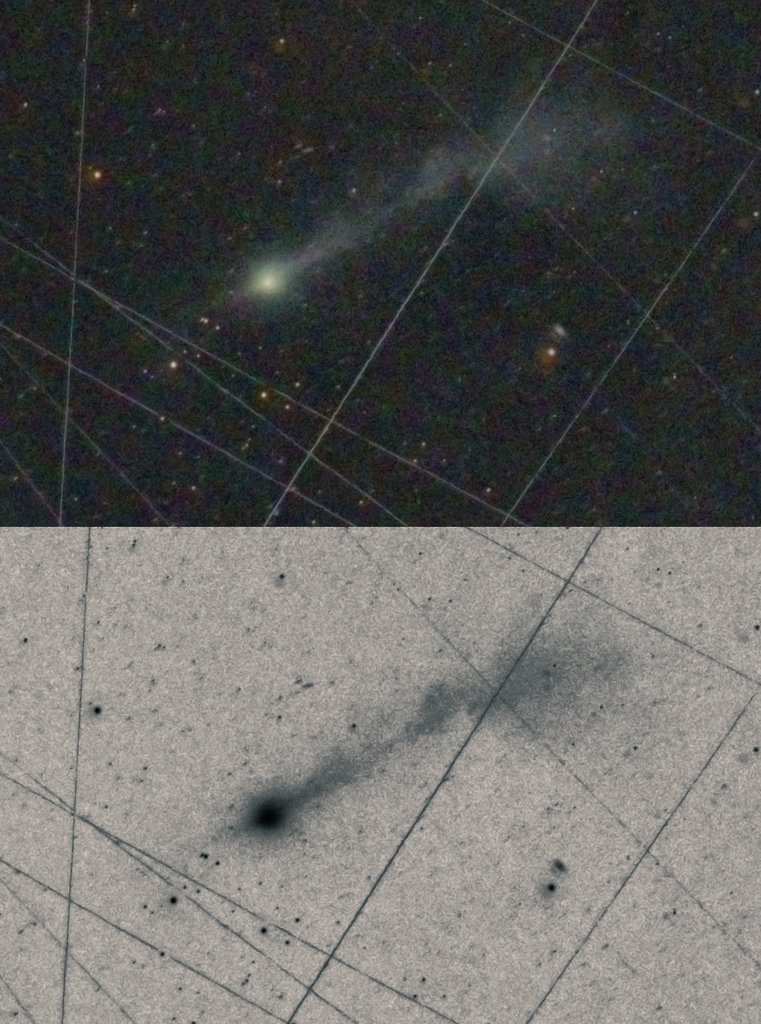
After the comet passed perihelion, new photographs taken in November 2025 revealed no visible tail at all. Even under powerful telescopes, the usual streak of dust and gas behind the comet was missing.
Astronomer Gonzalez Navarra, who viewed the comet through a telescope, described the sight as “still amazing to see,” even though the tail was absent. The comet appeared like a small blue-green dot, glowing faintly against the dark sky.
This unusual behavior immediately caught the attention of astronomers worldwide.
🔬 Possible Reasons for the Missing Tail
Scientists have proposed several explanations for this rare phenomenon. Here are the main theories in simple terms:
1. The Viewing Angle
The comet’s tail might be pointed almost directly toward Earth. If so, we wouldn’t see it stretched out from our perspective — it would look like it’s missing even though it’s there.
2. Heavy Dust and Slow Movement
Researchers think 3I/ATLAS might be releasing large dust particles instead of fine dust. Big particles move slowly and don’t get pushed far by sunlight, making the tail short or invisible.
3. Low Gas Activity
The comet could simply have less gas and dust than normal comets. Some believe its icy surface may be covered by a thick crust, preventing gases from escaping and forming a tail.
4. Strange Chemical Makeup
The James Webb Space Telescope found that 3I/ATLAS contains a high amount of carbon dioxide (CO₂) compared to water. This unusual mixture could affect how the comet reacts to heat from the Sun.
5. Interstellar Origins
Because 3I/ATLAS came from another star system, it might have been exposed to cosmic radiation for millions of years. This could have changed its surface and made it behave differently from normal Solar System comets.
🌍 Why This Discovery Matters
The strange behavior of 3I/ATLAS isn’t just interesting — it’s scientifically important. Here’s why:
- It expands our knowledge of comets. If a comet can exist without a tail, our understanding of comet formation may need updating.
- It reveals new chemistry. Studying 3I/ATLAS’s gases helps scientists learn what materials exist in other star systems.
- It connects comets and asteroids. Some experts now wonder if 3I/ATLAS might be more like an asteroid than a comet.
- It shows the diversity of space. Each interstellar visitor is a reminder that our Solar System is not unique — and that countless other worlds may exist beyond.
🔭 When and Where It Was Seen
- Discovered: 1 July 2025 by ATLAS telescope, Chile.
- Closest to the Sun: 29 October 2025 (Perihelion).
- Reappeared for observation: 5 November 2025, seen faintly from Earth’s morning sky.
- Location: Near the eastern horizon, visible through telescopes before sunrise.
Although the comet was too faint to see with the naked eye, advanced telescopes captured its soft glow — a sight both mysterious and beautiful.
ALSO READ : Sridhar Vembu: The Man Who Built Zoho From a Small Village to a Global Tech Empire
💡 Key Facts About 3I/ATLAS
| Feature | Details |
|---|---|
| Type | Interstellar Comet |
| First Detected | July 2025 |
| Origin | Outside the Solar System |
| Orbit | Hyperbolic (unbound to Sun) |
| Closest Approach | 29 Oct 2025 |
| Tail Visibility | Almost none |
| Composition | Rich in CO₂, low in water ice |
| Observation | Visible only via telescope |
Q1: What makes 3I/ATLAS special?
It is only the third known comet from another star system, and it showed almost no tail, which is rare and scientifically important.
Q2: Can we see 3I/ATLAS from Earth?
It is visible only with a telescope, near the eastern horizon during early morning hours. It is not bright enough for the naked eye.
Q3: What can scientists learn from it?
It helps astronomers understand how objects from other star systems differ from our own comets and could reveal clues about how planets form.
🔥 What Scientists Are Learning
The absence of a tail in 3I/ATLAS may help scientists refine their models of how comets form and behave. It might prove that not all interstellar visitors follow the same pattern.
Some experts think 3I/ATLAS is part of a larger story — evidence that our galaxy is full of ancient, icy travelers drifting between stars. Others believe it might be a fragment of a destroyed planet or comet from another system.
Either way, 3I/ATLAS is a reminder that the universe still holds many mysteries.
🌠 Conclusion
The story of Interstellar Comet 3I/ATLAS is a perfect example of how unpredictable space can be. Instead of showing a bright tail like most comets, it surprised us with silence and mystery.
While its missing tail left scientists scratching their heads, it also opened new doors of curiosity about the universe beyond our Solar System. Each discovery like this reminds us that space is full of wonders — and that every strange object teaches us something new about where we come from.